Options Traders…heads Up on Netflix!

One of the hardest things for me to remember is not to believe everything I see. I am a sucker for the latest “can’t lose” strategy supported by the experts. This morning I ran across a trade that looked too good to be true. I think it is, but I think it is instructive to walk through the potential hidden land mine. The event is the Wednesday afternoon release of NFLX earnings but there is a hidden trap for option traders using one commonly used earnings play structure.

The construction of the play is that of a “double calendar” spread. The underlying profit engine is an attempt to exploit the routinely seen spike in implied volatility (IV) of the options series most closely following earnings release. In this case, NFLX has weekly options which expire 48 hours after the scheduled announcement.

In order to understand the situation, let’s walk through the components step-by-step. First, is the routinely observed spike in IV seen as earnings release approaches present? As shown in the options pricing matrix below, the IV of the weekly options is substantially higher than the next series in time, the February monthlies:

NFLX Options Matrix
NFLX Options Matrix

Next, we need to get an idea of the magnitude of the price movement expected by option traders. This price range can be imputed from the break even points of the at-the-money straddle in the front most options. As shown in the graph below, this analysis gives a current expected price range of 167-203 following earnings release.

NFLX Straddle
NFLX Straddle

Now let us consider a double calendar spread with strikes selected to encompass this anticipated price range. To review quickly, a calendar spread consists of selling a short dated option while buying a longer dated option at the same strike price. An example of such a trade in NFLX is presented below:
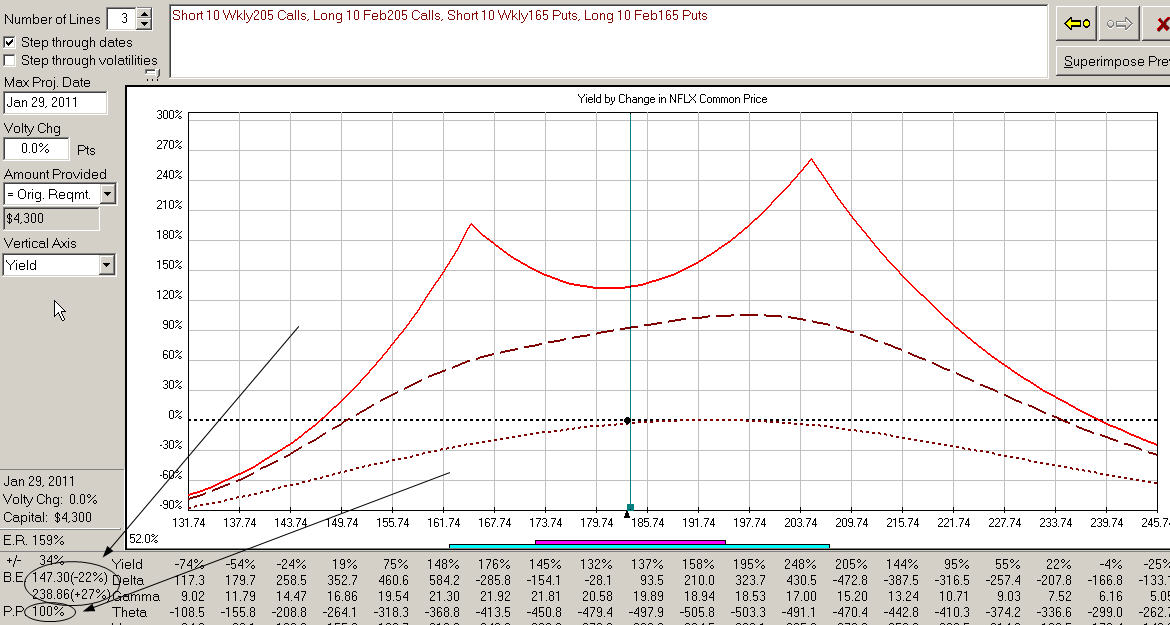
NFLX Doublecal
NFLX Doublecal

That looks pretty sweet, right? We have projected break even points of 147.3 and 238.86 and a probability of profit (P.P.) of 100%. So all we have to do is put this on, wait for earnings, and barring any huge surprise, we take profit of 100% or more home.

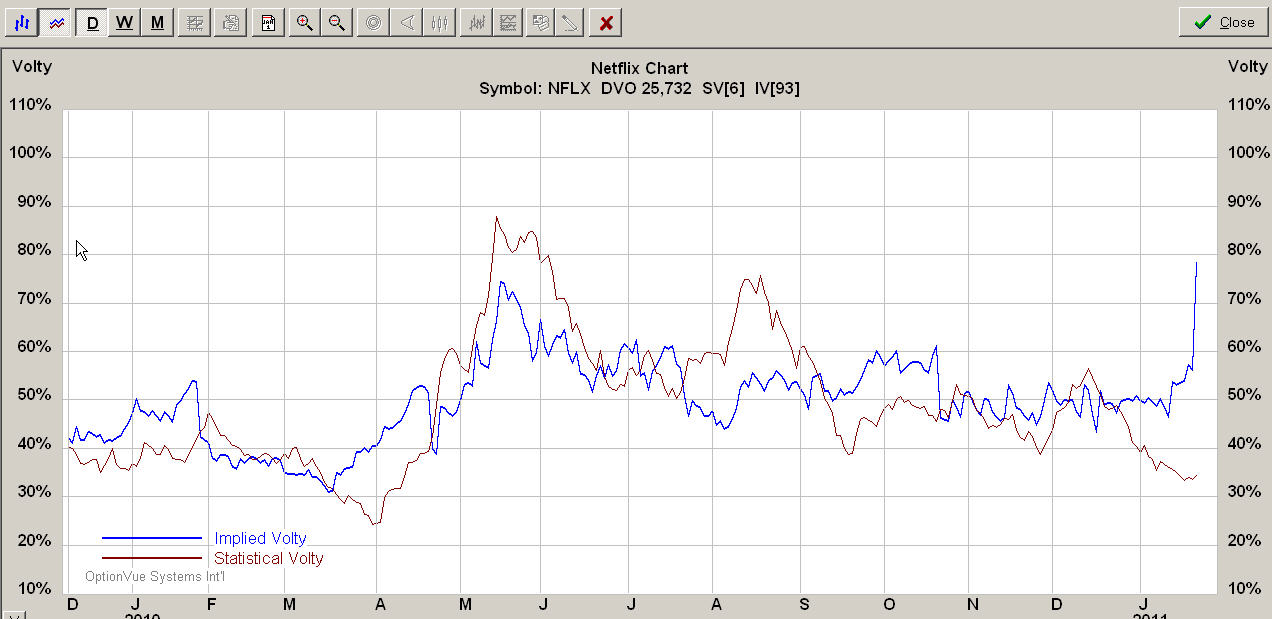
What could possibly go wrong? Unfortunately there is a high probability of a sequence of events that will totally erase any profits and likely result in a loss. Go back and look at the option pricing matrix above and focus on the IV of the options we are buying. These options trade at a volatility of 60%. Is that high or low? You tell me from this historic graph of volatility in NFLX options:
NFLX Volatility chart

As you can see, the current level of volatility that you are buying in the long legs of the calendar is quite elevated on a historical basis. Furthermore, the spread between statistical (historical) and implied volatilities has rarely been greater. This combination of events sets up a high probability of a “volatility crush” on the options you hold long as part of the spread. The moving parts of this crush are:

1. Cessation of the “bleeding” of juiced IV from the weeklies into the monthly series as the weekly option IV deflates massively.

2. Convergence of IV toward the value of historical volatility in order to close the huge divergence in the levels currently present.

This situation sets up a high probability for a negative impact on the trade which will almost certainly result in a loss. Do I know these events will transpire? Absolutely not, and I may be 100% wrong. Survival as an options trader is all about recognizing high probability events and structuring trades accordingly. No free cheese here; time to move along to the next trade.

If you would like to receive these reports you can register here
The Current State Of The Markets

The State of the Markets: In his latest market forecasts, David Banister outlines his cautions to the savvy investor and speculator………………………..

I’ve been forecasting a Mid January top in the SP 500 (Us Markets) for multiple weeks now well in advance. My work had looked for 1285 as a minimal upside rally from the 1173 4th wave lows. The range was 1285-1315, we have been to 1296 but that pretty much should have capped off the rally. Here are some further thoughts:

Copper, Gold, Silver- All topping and rolling over for now. A few weeks ago I began to go bearish on Gold (And with it of course Silver), and the Elliott Wave patterns became very muddy and unclear. This was a warning signal. Also, the inability of Gold to pierce through the 1425-30 highs for a 3rd attempt indicated a triple top failure which I eluded to in an Email bulletin a few weeks back. The Gold, Copper, Silver topping and rollover movements are warning signals to be more cautious. Gold should work down to 1270-1280 eventually, and Silver to 25-26.50 ranges likely.

Small Cap Index- The TZA ETF I suggested on TMTF recently had a huge 2 day reversal rally on Thursday and Friday of this trading week. TZA Closed just over 16 and I see it moving to 19-20. We are long also in my ATP advisory service for insurance and gains potential. The Russell 2000 is rolling over first, which makes sense because the sentiment and strong economic rebound from the summer lows has peaked out. Small Caps are likely to correct the hardest in this wave pattern down, and so we shorted them instead of shorting the large caps or SP 500. To wit, this week the small caps dropped 3.5% and the SP 500 only 0.8%.

IBD 100- The Investors Business Daily top 100 fell 5.4% this week collectively. A quick scan of the charts on those 100 reveals a lot of topping and weakness patterns to me. These would be considered leader small cap and mid cap growth stocks, and suggests further evidence of continuing correction in the markets.

Elliott Wave theory is scoffed at by many investors because they have been led to believe that Robert Prechter is apparently the only person on earth who has a license to use them. I’ll reserve my comments on his abilities, but you can gather that I tend to often disagree with his views and leave it at that. EWT works extremely well in the right hands, and that is why I launched TMTF last year, to share my views and my methods. This has allowed me to confirm summer bottoms at 1040 this year based on the movement from 1120 to 1040 (Which we also forecast). This allowed me to call a top on November 5th at 1225 after going just over my 1220 predictions made weeks in advance. This allowed me to call a bottom 4th wave at 1173-75 and a resulting rally to 1285 in advance. Not to mention April 2010 and January 2010 tops within days. Still think EWT is bunk? Try ignoring those who are biased and trade their biases. I dont trade Gold, Silver, or the SP 500 futures or indexes… that allows me to remain 100% objective and not force wave counts into my personal opinions.

EWT is not perfect, but nor is any forecasting methodology or technical analysis strategy. They all have their flaws. However, I try to blend in a few elements to back up my EW forecasts, so as to eliminate too many mistakes. Sentiment readings for one, and Fibonacci sequences for another.

Bottom line: I continue to be cautious on the markets and believe the SP 500 will drop to 1170-1180 on the LOW END, with 1210-1229 possible as the shallower end of a correction. The Russell 2000 will take the hardest hit, and probably has another 8-9% downside left before a bottom pivot. We remain long TZA to short that index at 3x multiple over at my ATP service. I have not shorted the SP 500 or large Caps on purpose, because I think the best place to short is small caps. I continue to recommend high cash positions for now (Im about 40%) so that you have money to buy into an oversold wave 2 bottom in the markets when it occurs. Gold will continue to correct with a bounce at 1310-1320 areas likely. I see it getting to 1270-1280 though as most likely.

Large Caps are likely to outperform small caps in 2011, as the bulk of the economic trough and rebound have now occurred and been priced in. Gold may struggle for several months but has a shot at hitting $1500-$1515 by years end, but one month at a time. That said, selective stock picking will always have the ability to trounce the index averages, and that is what I do over at ATP (ActiveTradingPartners.com).

Stay tuned.
David Bansiter

Apple And Goldman Crash, But Is the High Still Coming?

Stock Trading Patterns

On the 19 Jan the stock market bled out with a river of red candles. All of the recent gains vanished in one session. Strong selling volume sessions like this are typically a warning sign that distribution selling is starting to enter the market.

Distribution selling is when the big money players start unloading large positions in anticipation of a market top. They do try to hide it by selling into good news or earnings when the average investors are buying into all the hype of better than expected earnings on the news. As average investors jump into the market because of the good news, this extra liquidity helps the big money players (banks, hedge funds, etc..) sell large amounts of their positions to the eager buyers. This is why the “buy on rumor and sell on the news” saying is kicked around wall street….

To me, panic selling is typically seen as a bullish sign to enter the market simply because if everyone is/has rushed to the door to sell what they own, then really most of the down side risk has been taken out of the market. That being said after an extended multi month rally and higher than selling volume I look at it more like distribution selling and a shift in momentum.

I feel the precious metals sector will be starting something like this in the near futures, and possibly it has already started as seen in the rising volume on the down days.

Let’s take a look at the charts…

AAPL – Apple Stock 10 Minute Chart
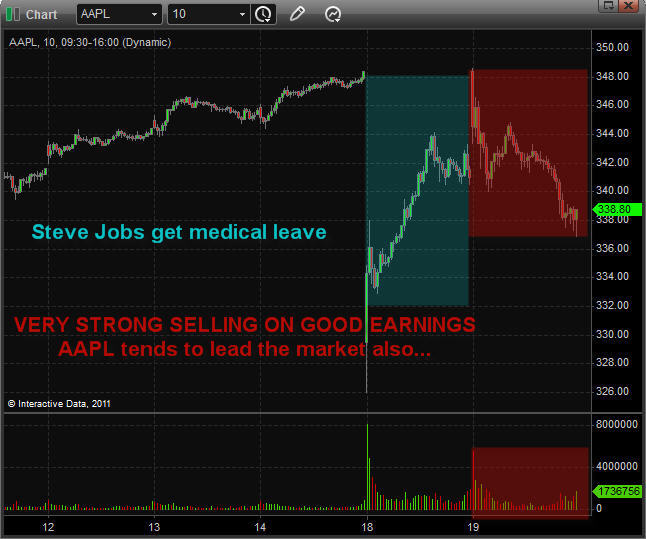
Two days ago AAPL shares took big hit because of some medical issues with the CEO, the shares did float back up. But what is important here is the distribution selling which took place after Apple came out with much better than expected earnings. The general public loves to buy good news especially when it’s for a famous company. But large sellers stepped in unloading as much of their position as they could before making it look to obvious.

The average investor listening on the radio or catching snippets on the news do not pick up on these things which is why the big money players can get away with this over and over again.

Panic Selling
Panic Selling

GS – Goldman Sachs 10 Minute Chart
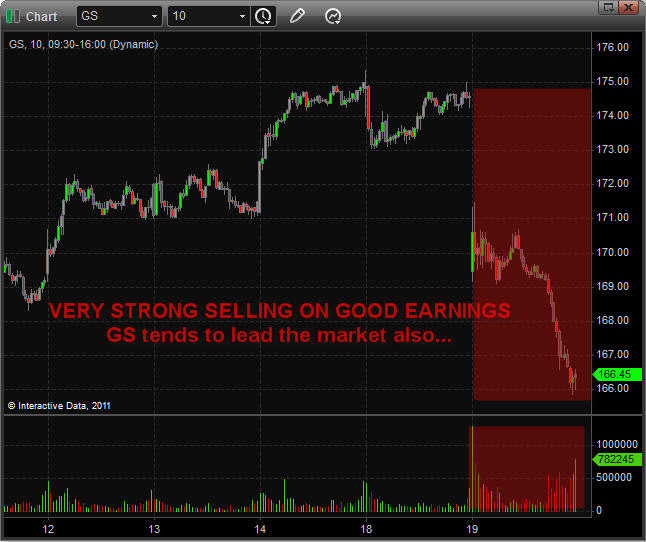
Goldman came out with average earnings being just above estimates and the share price took a beating with very strong volume.

Distribution selling looks to be entering the market and this is a bearish sign. I would not be surprised if we see the market top out in the next 5-10 trading sessions.

SPY – SP500 10 Minute Chart
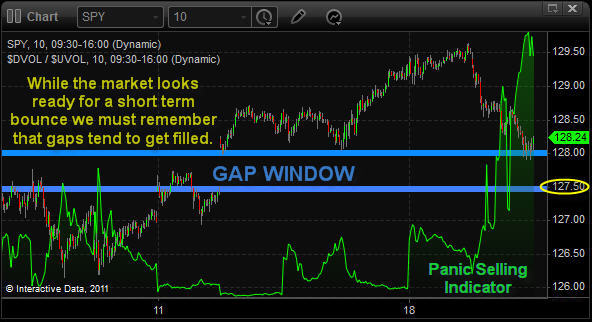
Here you can see my green panic selling indicator spiking up much higher than normal dwarfing the past sell off spikes. This makes me think the big money is now starting to unload which will shift the current upward momentum to more of a sideways whipsaw type of price action. Eventually it will roll over and a new down trend will start.

As you can see from this chart the SP500 is trading down at a support level so a bounce is likely going to take place. If in fact today was the first distribution day then the big money should let the price inflate back up to the recent highs and possibly make a new high to help keep investors bullish before the hit their SELL BUTTON again… They like to play these games and understanding them is a key part of trading. Expect choppy price action for a week or two…

Silver Daily Chart – The Next Wave of Selling?
I look at silver and gold as one… so what I show here is the exact same for gold.

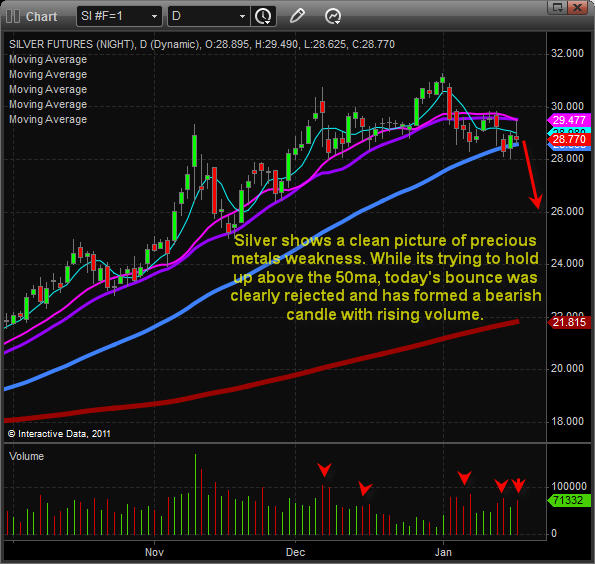
As you can see silver is trading under 3 of its key moving averages and todays bounce was sold into after testing the 14 and 20 period moving averages.

Take a looking at the bottom of the chart and you can see distribution selling volume as the spikes are all down days. If silver breaks below the $28 level then we could easily and quickly see the $26 and maybe even the $24 level.

Silver trading pattern

The Mid-Week Market & Metals Trading Conclusion:
In short, the financial power players are pulling out all the tricks to shake traders out of their positions. A lot of people shorted the market in the past 2 weeks only to get hung out to dry and most likely stopped out of their short positions for a loss. Fortunately we did the opposite taking another long position in the SP500 ETFS because my market internal indicators, market breadth and simple trading strategy clearly pointed out that the average investor was trying to pick a top by shorting the market. As we all know, the market is designed to hurt the masses which is why I focus on the underlying trends, price action, volume and market sentiment for timing trend changes.

That being said, I still think the market could grind higher and make another new high. But any rally or new high will most likely get stepped on with heavy selling. Expect strong selling days followed by a couple days of light volume sessions where the price drifts back up into resistance levels. This could take a week or two to unfold so don’t jump the gun and short yet. It’s best to see more distribution selling before picking a top.
If you like this trading reports or if you would like to get my daily pre-market trading videos, intraday charts, updates and trade alerts be sure to join my newsletter:

Chris Vermeulen

How to Stock Pick Or Choose the Best Share to Buy And Sell in Malaysian Stock Market?

Stock Picks
Stock Picks

How to stock pick or choose the best share to buy and sell in Malaysian stock market?

By Martin Wong

Honestly speaking, it is difficult to stock pick the best share to buy in the bull market as most good counters/stocks have raisen a great deal. While in the bear market nobody can guarantee that the current low stock price has reached its bottom already.

For the typical investor, says Mr. Joe Average, he who regularly chooses the best stocks based on hearsay, analysts’ stock reports or economic forecast. He watches local & international business channels or listen to well-dressed people talking on TV who thinks they are very knowledgeable. And finally, he believes them – else they would not be on TV, right???

The average investors/traders pick a stock no one has really heard about and hope it would make them really, really rich! However the chosen stock could go in any direction. This is highly risky not knowing whether the company can produce future earnings and profits. How to choose the best stocks usually involves blue chips stock that are household name companies or fairly well known companies in Malaysia or globally. You can choose the best stock over the markets or the best sector they are in.

Subscriber can email me for stock-pick-the-best list.

————————————————————————-

For most average investors/traders I have interviewed, learning to stock pick the best share to buy or sell can be difficult because they either have little or no plan at all as to why they are buying at the first place. The first question we need to ask ourselves is “why are we buying or do we have investing stock goals or trading strategies” but unfortunately many traders and investors cannot even provide an answer. If you are a long term investor (I do not support buy, hold & pray), you would have a very different buying system criteria to a short term trader who buy and sell within very short period of time. So it is very important that you need to be very clear of your investing goals and trading objectives. Make sure you can differentiate between your long term investment goals and short term trading strategies.

From my own experience having been in this online stock trading business for years that the simpler the system for stocks picking the better, and the good news is you do not need to rely on stock market experts or stock market gurus to tell you what to buy or sell. All you need is some effort, hard work and lots of practice with a few tools available for a very low cost. The process I use to pick the best stock to buy is largely a technical analysis which includes many elements of fundamental analysis at the macro-economic level. The process is fully explained in my investing & trading course, but the principles are as follows.

————————————————————————-

We start to look at the Bursa Malaysia Saham stock market companies as a pool. We begin to make selection on the individual stocks or the best sector and at this stage the very simple and common indicators are used. Using a technical analysis tool, I would identify some possible prospects for the best stock to buy and are placed on a watch list and monitored daily. How long they remain in the watchlist folder depend on the daily stock price chart.

We wait for clues in changes in the technical analysis landscape to trigger our buy signal and buy order. After placing the buy order we always put a stop loss in case the price trend reverses suddenly. The stock market is so uncertain that we have to protect our capital. The only technical analysis tool that I use for the above analysis is a simple end of day charting package called MetaStock software which I have written technical codes (filtering the required best sector or by price movements) to do just the stock picking.  

In short, the process to choose the best stocks to buy starts with the macro level and moves down to combination of using both technical and fundamental data. Although it sound very complicated, it is very easy to use as many of our course graduates have used them for years with great success. For new traders and investors, it is better to start off paper-trading to allow you to overcome the steep learning curve e.g. various trading strategies, unpredictable stock market behaviour and comfortable with placing order online for online trading.
————————————————————————-

To be successful, you have to model after successful investors and traders who been through the blood and sweat who know how to pick the best stock to buy. Success lies on yourself and the effort you put in at the start – I hope the above article would help to put you into the right path. For more information, goto www.traderstruthrevealed.com for the Malaysian stock market.

THE CHINESE Stock Market: Showing Signs of Tremendous Growth

The NASDAQ is the world’s largest stock trading hub. Investors, brokers, traders all have their stakes running from a few cents to billions of dollars established here. Along with the New York Stock Exchange, this is the bread and butter stuff the world looks up to.

China is a rising name in world economy. The pace at which this country is working towards strengthening its grip on world affairs relating to politics, economy, sports, and culture, is astonishing to say the least. The number of Chinese corporations, from small and medium enterprise companies, all are making their presence felt across the globe. Whether it be hardware for manufacturers in the automobile, consumer appliance sector or software for IT firms, China is ahead of every one else. The list Chinese Stocks NASDAQ exchange outnumbers those of any other country in the world. The Chinese Pink Sheet Stock traders are considered the more aggressive among their counterparts from other countries. Investing is more intense and there seems to be a higher willingness towards risk taking among the Chinese.

The Chinese Stock research has shown a rising number of investors riding high on the country’s stupendous economic performance during the last one decade. Markets are bullish most of the time of the year thanks to the encouraging GDP figures. The recent financial meltdown had many nations seeking desperate countering measures. China however had its crucial sectors fairly well knit together and this helped the country sail through those tough times with minimum fuss. China is a heavy investor in defense equipment and this constitutes a considerable share of its expenditure. Stocks of arms and defense equipment providers are noted to be quite preferred among the Chinese investors. With share prices among the highest in the market, they are among the most tempting of all investments.

The Chinese have always maintained a strictly communist approach towards its political dealings at the international level. This reflected in its economic outlook as well. But that was up till now. From everything state-owned, China has finally let itself, its approach change according to the changing world order. There is now an increased public-private interaction. The public sector has rid itself of much of economic dealings and has allowed booming Multi National Corporations to set up station in its so far state controlled market. No wonder this ‘transfer of power’ coupled with the robust economic past guarantees China a much envied position in world markets in the near future. The tag of a “Superpower”? Well, it’s just a matter of time and China will see this title in its kitty too.